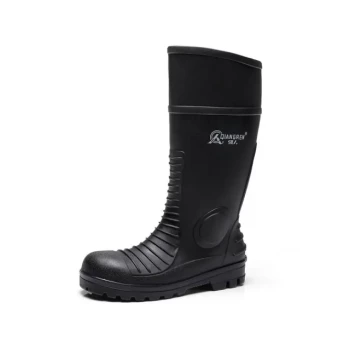
La transition de l'agenouillement à l'accroupissement dans l'eau d'inondation crée un test de contrainte mécanique complexe pour les chaussures de protection. Alors que la charge principale passe des genoux aux semelles, les chaussures sont soumises à des exigences soudaines en matière d'adhérence instantanée et de stabilité structurelle. Cela se produit pendant que le centre de gravité de l'utilisateur se déplace et que la surface exposée à la résistance de l'eau change, créant des déséquilibres de couple potentiels qui peuvent entraîner des chutes.
Le défi essentiel réside dans la capacité de la chaussure à fournir un "bras de levier de support stable" lors du changement dynamique de charge. Si la semelle ne peut pas générer une adhérence instantanée ou contrer les déséquilibres de couple lorsque le centre de gravité s'élève, l'utilisateur risque de basculer ou de subir une instabilité secondaire.
La mécanique du transfert de charge
Changement du point de contact
Lorsqu'un utilisateur passe d'une position agenouillée, le poids du corps est transféré du tissu du vêtement sur les genoux aux semelles de la chaussure.
Ce n'est pas un processus graduel ; c'est un changement rapide du point d'appui principal. La chaussure doit accepter cette charge immédiatement sans se déformer ni glisser.
Gestion d'un centre de gravité dynamique
Alors que l'utilisateur se relève en position accroupie, son centre de gravité se déplace verticalement et horizontalement.
La chaussure agit comme base de support pour cette masse en mouvement. Les chaussures de sécurité haute performance doivent stabiliser ce mouvement pour éviter que l'utilisateur ne bascule dans l'environnement fluide.
Pressions hydrodynamiques et structurelles
Résistance variable à l'eau
La transition modifie la surface du corps exposée à l'eau.
Lorsque la posture change, la pression de l'eau exerce une force sur différentes parties du corps et de l'équipement. La chaussure doit ancrer l'utilisateur contre ces courants externes changeants.
L'exigence d'une adhérence instantanée
Étant donné que le transfert de charge est rapide, il n'y a pas de temps pour que la bande de roulement "se tasse" dans le substrat.
La chaussure nécessite une "adhérence instantanée". Le coefficient de friction doit être suffisamment élevé pour bloquer le pied au moment où le poids est appliqué, même sur des surfaces submergées et glissantes.
Points de défaillance critiques : couple et levier
Le bras de levier de support
Pour se relever en toute sécurité, la chaussure doit fonctionner comme un levier rigide.
La référence identifie le besoin d'un "bras de levier de support stable". Cette rigidité mécanique permet à l'utilisateur de pousser sur le sol efficacement sans que la chaussure ne s'effondre sous la contrainte.
Prévention du déséquilibre de couple
Une défaillance du levier entraîne un déséquilibre de couple.
Si la chaussure est instable, les forces de torsion (couple) générées pendant le relèvement restent incontrôlées. Ce déséquilibre est la principale cause de basculement ou d'"instabilité secondaire" dans les conditions d'inondation.
Comprendre les compromis
Stabilité vs. Flexibilité
Pour fournir un bras de levier stable, les chaussures nécessitent souvent une construction de semelle rigide.
Cependant, une rigidité excessive peut limiter la flexion naturelle du pied. Cela rend la transition mécaniquement efficace mais potentiellement inconfortable pendant de longues périodes de marche.
Surface vs. Traînée
Une semelle plus large crée une plateforme plus stable pour le centre de gravité.
Inversement, une semelle plus grande augmente la surface exposée à l'eau. Cela augmente la traînée hydrodynamique, nécessitant plus d'effort pour déplacer le pied dans l'eau d'inondation.
Optimisation de l'équipement pour les environnements dynamiques
La sélection des bonnes chaussures de protection nécessite d'équilibrer la stabilité avec les réalités de l'environnement d'inondation.
- Si votre objectif principal est la stabilité lors du levage de charges lourdes : Privilégiez les chaussures avec un châssis rigide qui maximise le bras de levier de support pour éviter les déséquilibres de couple.
- Si votre objectif principal est le mouvement rapide : Privilégiez les composés de semelle qui offrent une adhérence instantanée maximale pour gérer les transferts de charge rapides sur des surfaces glissantes.
Des chaussures d'inondation efficaces doivent servir d'ancrage mécanique, transformant un moment de vulnérabilité en un mouvement contrôlé et stable.
Tableau récapitulatif :
| Facteur de défi | Impact mécanique | Exigence de la chaussure |
|---|---|---|
| Transfert de charge | Passage rapide des genoux aux semelles | Intégrité structurelle immédiate et non-déformation |
| Centre de gravité | Déplacement de masse vertical et horizontal | Stabilisation dynamique pour éviter le basculement |
| Résistance à l'eau | Changement de la traînée et de la pression hydrodynamiques | Ancrage sécurisé contre les courants externes |
| Besoins de traction | Temps minimal pour l'adhérence de la bande de roulement | Adhérence instantanée élevée sur les surfaces submergées |
| Gestion du couple | Forces de torsion pendant la montée | Bras de levier de support rigide pour éviter le renversement |
Sécurisez votre personnel avec les chaussures de sécurité haute performance 3515
Naviguer dans des environnements extrêmes comme les zones inondées nécessite plus que de simples équipements standards ; cela nécessite une stabilité conçue. En tant que fabricant leader à grande échelle au service de distributeurs mondiaux et de propriétaires de marques, 3515 fournit l'expertise technique et l'échelle de production nécessaires pour relever ces défis mécaniques. Notre série phare Chaussures de sécurité est spécifiquement conçue pour fournir le bras de levier de support stable et l'adhérence instantanée nécessaires aux transferts de charge complexes dans des conditions dangereuses.
Des bottes tactiques et des équipements d'extérieur aux chaussures d'entraînement et aux options formelles, nous offrons des capacités de production complètes pour répondre à vos divers besoins en gros. Faites équipe avec 3515 pour offrir une fiabilité qui résiste aux pressions les plus fortes.
Contactez-nous dès aujourd'hui pour discuter de vos besoins en fabrication en gros
Références
- Guo Xin, Xiaojing Li. Analysis of Self-Rescue Possibilities for Pedestrians in the Aftermath of Destabilization during a Flood Event. DOI: 10.3390/w16091218
Cet article est également basé sur des informations techniques de 3515 Base de Connaissances .
Produits associés
- Bottes de sécurité personnalisables en gros Fabrication de chaussures durables et de protection
- Chaussures de sécurité sportives en daim premium pour vente en gros et commandes groupées
- Wholesale Anti-Smash & Puncture-Proof Safety Shoes Fabrication sur mesure pour les marques
- Chaussures de sécurité haut de gamme avec baskets de sécurité à boucle rotative
- Chaussures de sécurité légères haut de gamme pour commandes en gros et en vrac
Les gens demandent aussi
- Pourquoi les bottes de sécurité industrielles à embout d'acier sont-elles nécessaires pour les opérateurs de machines ? Protection essentielle pour la sécurité
- Quelle est l'histoire des bottes de sécurité à embout d'acier ? De l'invention allemande à la norme de sécurité moderne
- Quels sont les différents types de bottes de travail à embout d'acier ? Choisissez la bonne botte pour votre travail
- Quels sont les avantages et les inconvénients des bottes de travail à embout d'acier ? Un guide pour une protection maximale vs. le confort
- Quelles sont les caractéristiques communes des bottes de travail à embout de sécurité, quel que soit leur style ? Protection essentielle expliquée